PMBOK 8th Edition: How AI Automates the 12 Project Principles
Discover how artificial intelligence revolutionizes project management by automating the 12 core principles introduced in PMBOK 8th Edition. From stewardship to change management, see how AI transforms theory into practice.
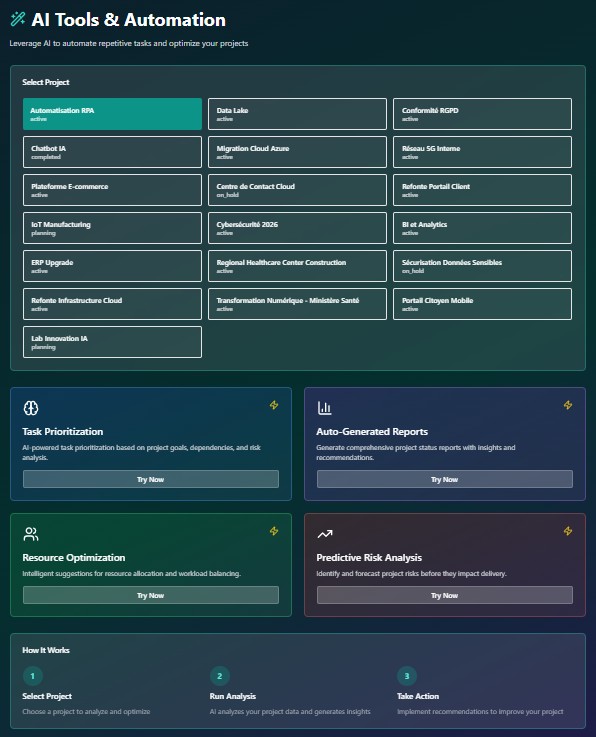
PMBOK 8th Edition: How AI Automates the 12 Project Principles
The Project Management Body of Knowledge (PMBOK) 8th Edition introduced a paradigm shift by focusing on 12 universal project management principles rather than rigid process groups. As artificial intelligence continues to reshape industries, project management offices (PMOs) are discovering that AI doesn't just support these principles—it automates them.
The Evolution: From Processes to Principles
The PMBOK 8th Edition marked a fundamental change in how PMI approaches project management. Instead of prescriptive process groups, it emphasizes principles-based thinking:
- Flexibility over rigidity: Principles adapt to any methodology (Agile, Waterfall, Hybrid)
- Universal application: Applicable across industries and project types
- Value-driven focus: Emphasis on outcomes rather than outputs
But here's the challenge: principles require continuous judgment, monitoring, and adaptation. That's where AI becomes transformative.
The 12 Principles & AI Automation
1. Stewardship: Be a Diligent, Respectful, and Caring Steward
Principle: Project managers must act with integrity, care for the organization, and ensure responsible resource allocation.
AI Automation:
- Resource optimization algorithms ensure budget and team allocation align with organizational priorities
- Ethical AI frameworks flag decisions that conflict with governance policies
- Automated compliance tracking monitors adherence to corporate standards and regulatory requirements
Example: AI-powered dashboards detect when a project exceeds its authorized budget threshold and automatically escalate to governance boards.
2. Team: Create a Collaborative Project Team Environment
Principle: High-performing teams require trust, collaboration, and psychological safety.
AI Automation:
- Sentiment analysis tools monitor team communication for signs of conflict or disengagement
- AI-driven workload balancing prevents burnout by redistributing tasks based on capacity
- Virtual collaboration assistants facilitate asynchronous teamwork across time zones
Example: AI analyzes meeting transcripts and Slack messages to identify team members who are disengaged, prompting proactive interventions.
3. Stakeholders: Be Proactively Engaged with Stakeholders
Principle: Continuous stakeholder engagement is critical to project success.
AI Automation:
- Predictive stakeholder mapping identifies who will be impacted by changes before they occur
- Automated communication workflows send targeted updates based on stakeholder interest levels
- Natural Language Processing (NLP) analyzes feedback to detect concerns or resistance early
Example: AI monitors executive email responses to project updates and flags when a sponsor is showing reduced engagement.
4. Value: Focus on Value
Principle: Every project decision should maximize business value delivery.
AI Automation:
- ROI prediction models estimate value realization for competing initiatives
- Value stream mapping AI identifies waste and bottlenecks in delivery pipelines
- Automated benefits tracking measures actual vs. projected value post-implementation
Example: AI recommends deprioritizing low-value features to accelerate delivery of high-impact capabilities.
5. Systems Thinking: Recognize, Evaluate, and Respond to System Interactions
Principle: Projects exist within complex systems; changes ripple across the organization.
AI Automation:
- Dependency mapping AI visualizes cross-project impacts and resource conflicts
- System dynamics simulation predicts downstream effects of project decisions
- Integration risk detection flags when changes in one system will break another
Example: AI detects that upgrading the ERP system will impact 12 downstream applications and auto-generates a risk assessment.
6. Leadership: Demonstrate Leadership Behaviors
Principle: Effective project managers lead by example, inspire teams, and navigate complexity.
AI Automation:
- Leadership analytics assess PM behaviors against competency frameworks
- AI coaching tools provide real-time feedback on communication effectiveness
- Decision support systems guide leaders through ambiguous situations with scenario analysis
Example: AI analyzes a PM's decision history and suggests when to shift from directive to servant leadership styles.
7. Tailoring: Tailor Based on Context
Principle: No one-size-fits-all approach; adapt methods to project context.
AI Automation:
- Methodology recommendation engines suggest Agile, Waterfall, or Hybrid based on project characteristics
- Template auto-generation creates customized governance frameworks
- Best practice libraries curate lessons learned from similar projects
Example: AI analyzes a new project's complexity, uncertainty, and stakeholder distribution to recommend an optimal methodology mix.
8. Quality: Build Quality into Processes and Deliverables
Principle: Quality is not inspected in—it's designed in from the start.
AI Automation:
- Automated testing pipelines ensure code and deliverable quality at every stage
- Defect prediction models identify high-risk areas before issues emerge
- Continuous monitoring AI tracks quality metrics in real-time
Example: AI detects that a software module has 3x more complexity than similar components, triggering additional code reviews.
9. Complexity: Navigate Complexity
Principle: Modern projects involve ambiguity, emergence, and non-linear dynamics.
AI Automation:
- Complexity scoring algorithms quantify technical, organizational, and environmental complexity
- Monte Carlo simulations model probabilistic outcomes under uncertainty
- Adaptive planning AI adjusts schedules dynamically as new information emerges
Example: AI identifies that a project has crossed into the "complex" domain and recommends switching to iterative delivery.
10. Risk: Optimize Risk Responses
Principle: Proactively identify, assess, and respond to threats and opportunities.
AI Automation:
- Predictive risk detection analyzes patterns to flag risks before they materialize
- Automated risk registers populate risks from historical project data
- Risk response optimization recommends mitigation strategies with cost-benefit analysis
Example: AI detects that vendor delivery timelines are slipping across multiple projects and escalates supply chain risk.
11. Adaptability and Resiliency: Build Adaptability and Resiliency into the Organization
Principle: Projects must respond to change without breaking.
AI Automation:
- Change impact analysis predicts how scope changes affect timelines, budgets, and resources
- Scenario planning AI stress-tests project plans against worst-case events
- Adaptive resource allocation reallocates capacity in response to shifting priorities
Example: When a key team member resigns, AI automatically redistributes tasks and updates the project baseline.
12. Change: Enable Change to Achieve the Envisioned Future State
Principle: Projects are change agents; success requires organizational adoption.
AI Automation:
- Adoption tracking AI monitors user behavior to assess change readiness
- Resistance prediction models identify stakeholders likely to resist transformation
- Personalized training AI delivers role-based learning paths for new systems
Example: AI detects that end-users are avoiding a new CRM system and triggers targeted training campaigns.
From Theory to Practice: AI-Powered PMOs
The PMBOK 8th Edition's principles are powerful—but only if applied consistently. Traditional PMOs struggle because:
- Humans can't monitor everything: 100+ projects with thousands of tasks exceed manual oversight capacity
- Principles require judgment: Deciding when to escalate, adapt, or intervene is cognitively demanding
- Data exists in silos: Risks, dependencies, and stakeholder feedback are scattered across tools
AI solves these challenges by:
- Continuous monitoring: AI never sleeps, analyzing project health 24/7
- Pattern recognition: AI learns from historical data to predict future issues
- Automated execution: Low-level decisions (e.g., scheduling) are handled automatically, freeing PMs for strategic work
Real-World Impact: AI + PMBOK in Action
Case Study: Enterprise IT Transformation
Challenge: A Fortune 500 company managing 200+ concurrent projects struggled with:
- Budget overruns on 40% of initiatives
- Stakeholder disengagement
- Reactive risk management
AI Implementation:
- Value principle automation: AI ranked projects by ROI, reallocating resources to high-value initiatives
- Risk principle automation: Predictive models flagged at-risk projects 60 days earlier than manual reviews
- Stakeholder principle automation: NLP analyzed executive communications, triggering engagement campaigns when interest waned
Results:
- 35% reduction in budget variance
- 50% fewer project escalations
- 28% faster delivery times
The Future: Principles-First, AI-Enabled PMOs
The PMBOK 8th Edition's principles represent the future of project management. But realizing that future requires AI:
- Augmented decision-making: AI handles data analysis; humans focus on judgment and leadership
- Proactive governance: AI detects principle violations before they escalate
- Continuous improvement: AI learns from every project, building institutional knowledge
What This Means for Project Managers
- Shift from execution to strategy: AI automates tactical work, elevating PMs to strategic advisors
- Master principles, not processes: Understanding why matters more than memorizing how
- Embrace AI literacy: The best PMs will know how to interpret AI insights and guide automated decisions
Getting Started: Implementing AI for PMBOK Principles
Step 1: Assess Your Maturity
- Which principles are you already practicing?
- Where do manual processes create bottlenecks?
- What data exists but isn't being used?
Step 2: Start with High-Impact Principles
- Risk (Principle 10): Predictive risk detection delivers immediate ROI
- Value (Principle 4): AI-driven prioritization prevents wasted effort
- Complexity (Principle 9): Complexity scoring helps allocate the right resources
Step 3: Integrate AI Tools
- PMO dashboards: Real-time project health scores
- Predictive analytics: Risk and issue forecasting
- Natural language processing: Stakeholder sentiment analysis
Step 4: Train Your Team
- PMBOK 8th Edition principles education
- AI tool adoption and interpretation
- Change management for AI-augmented workflows
Conclusion: The Principle-Driven, AI-Enabled PMO
The PMBOK 8th Edition's shift to principles was visionary. But principles without automation remain aspirational. AI transforms these principles from guidance into real-time governance:
- Stewardship becomes automatic compliance
- Stakeholder engagement becomes predictive outreach
- Risk management becomes early warning systems
- Value focus becomes continuous optimization
The question isn't whether AI will automate project management principles—it's whether your PMO will lead or follow.
Ready to Automate the PMBOK Principles?
My Virtual PCO is built on PMBOK 8th Edition principles, using AI to automate governance, risk detection, and value optimization.
Start your free 14-day trial and see how AI transforms principles into practice.
Additional Resources
- Download: PMBOK 8th Edition Principles Checklist
- Webinar: AI-Powered Project Governance
- Case Study: Fortune 500 AI PMO Transformation
- PMI PMBOK Guide 8th Edition
About the Author
This article is brought to you by My Virtual PCO, the AI-powered project governance platform trusted by enterprise PMOs worldwide.
MyVirtualPCO
Turn project insights into concrete action
My Virtual PCO adds an intelligence layer on top of your project tools to track health, risks, budgets, and key decisions.
- Free plan available with no time limit for 1 project
- Project health score, risk alerts, and dashboards
- Essential plan from $49/month when you need more
Comments (0)
Leave a Comment
No comments yet. Be the first to comment!